
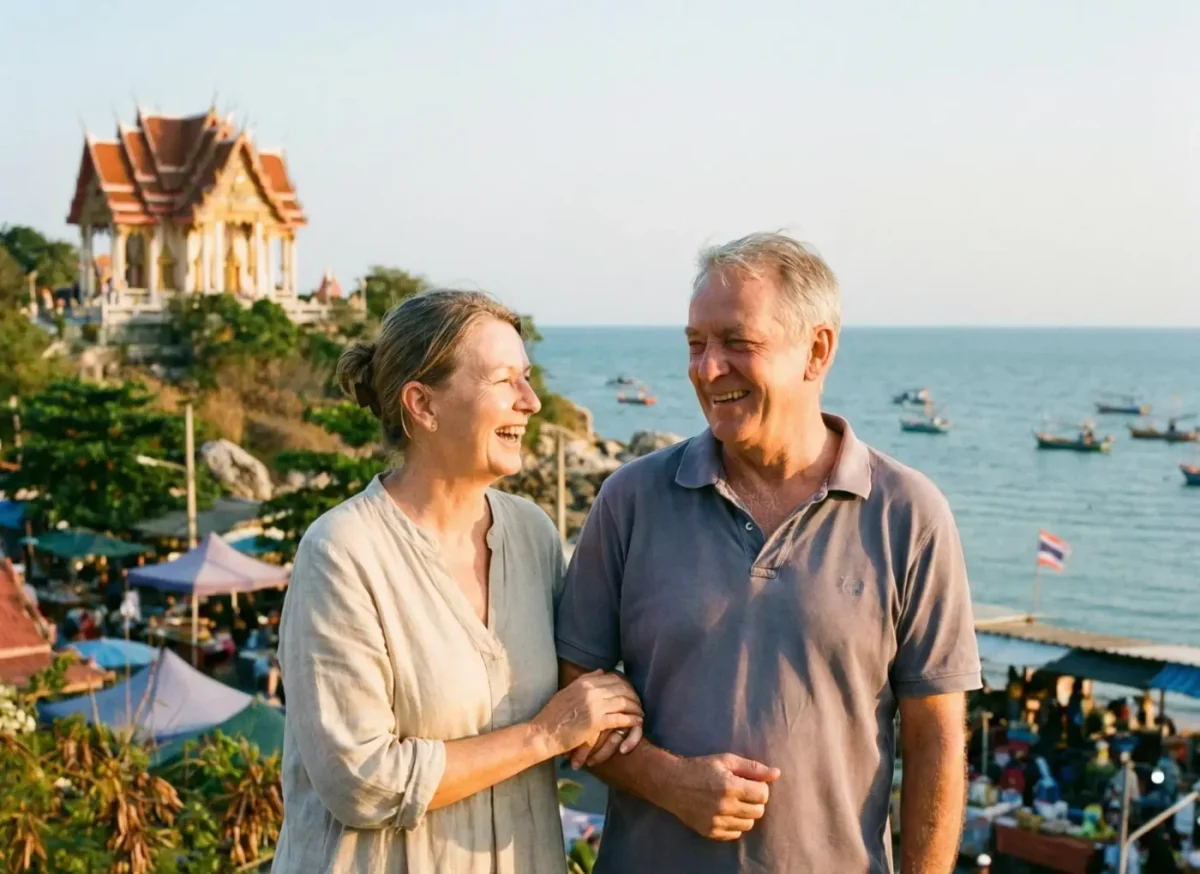
The first thing that strikes me on Monday morning is not the beach.
It is the conversations.
The sun has barely risen above the Gulf of Thailand when small groups have already formed along the promenade near Soi 61. Some walk briskly. Others move at a pace that suggests the walk itself is merely an excuse for the coffee that will follow. The sea is calm, fishermen are returning towards the pier, and a faint smell of salt drifts inland with the morning breeze.
Outside a small café near the Hilton, I join three regulars who have clearly performed this ritual many times before.
Hans, a retired architect from Hamburg, first came to Hua Hin fifteen years ago after spending decades designing office buildings throughout Germany. Beside him sits Peter, a former shipping executive from Rotterdam who thought he would stay six months and is now approaching his tenth year. Completing the trio is Colin, a retired school headmaster from Kent.
They greet passing walkers every few minutes.
"Watch this," Hans says with a smile.
Within thirty seconds somebody stops.
Then another.
Then a Thai woman selling fruit from a nearby cart.
Then a Swedish couple heading towards Khao Takiab.
The conversation expands and contracts like a tide.
"You see," says Peter, stirring his coffee. "Back in Europe everybody needs an appointment. Here life still leaves room for accidents."
It is perhaps the most concise description of Hua Hin I hear all week.
After breakfast, the beach slowly fills with its second wave. Some people are exercising. Others are simply sitting beneath the casuarina trees. Nobody appears particularly concerned with efficiency. Thailand's famous sabai sabai attitude is difficult to translate accurately. It does not mean laziness. It means allowing life to unfold without constantly forcing it forward.
The concept seems contagious.
By Monday afternoon I find myself at Black Mountain Golf Club.
The course itself is immaculate, but what interests me more is the terrace overlooking the final hole. Players finish their rounds and immediately settle into long lunches that stretch effortlessly into the afternoon.
There I meet Margaret and John, both from Melbourne. John spent forty years in construction; Margaret was a nurse.
"We actually play less golf than people think," Margaret confesses.
"So why come?"
She gestures around the terrace.
"Because somebody is always here."
That answer repeats itself throughout the week in different forms.
On Tuesday morning I visit a yoga class held near the centre of town. Afterwards, half the participants drift naturally towards breakfast at Market Village.
One woman, Marianne from Copenhagen, tells me she arrived after losing her husband six years earlier.
"The first year was difficult," she admits. "You leave your country and suddenly realise you need to build a life again."
What surprised her was how quickly Hua Hin made that possible.
By noon, Market Village has become a social hub. Retirees occupy cafés, exchange news, discuss upcoming concerts, compare healthcare experiences and plan dinners.
A coffee costs perhaps seventy or eighty baht. Lunch can still easily be found for under two hundred baht. Nobody becomes wealthy from retirement in Hua Hin, but many discover that their pensions suddenly stretch far enough to permit a comfortable social life.
Wednesday takes me to a volunteer project supporting a local school on the outskirts of town.
Here I meet Bob, a retired engineer from Canada, who spends two mornings a week helping maintain facilities and assisting with English conversation.
"After retirement I thought I wanted to do nothing," he laughs.
"It took me three months to realise I hated doing nothing."
Later that day, several volunteers gather for lunch at a roadside Thai restaurant where everybody seems to know the owner.
The food arrives quickly. Nobody rushes.
The owner notices a misplaced order and shrugs with a smile.
"Mai pen rai."
Nobody complains.
Another dish appears.
The conversation continues.
The incident lasts perhaps ten seconds before being forgotten.
The phrase appears repeatedly throughout my stay. It reflects something deeper than tolerance. It reflects a willingness not to allow small inconveniences to dominate one's day.
By Thursday evening I am attending a gathering at one of the many restaurants around the lake area near Soi 112.
The group includes a former airline captain, a Swiss watchmaker, an Irish accountant, a Norwegian physician and two Thai business owners.
Had they remained in their home countries, their paths would likely never have crossed.
Yet here they sit discussing local festivals, grandchildren, restaurant openings and weekend plans.
Somebody mentions a classical concert.
Another suggests a charity event.
A third recommends a new café.
The evening evolves not through planning but through possibility.
Friday brings me to Cicada Market.
The market has become one of Hua Hin's most recognisable gathering places. Families wander between food stalls while musicians perform beneath the trees. Retirees mingle with tourists and local residents. Artisans sell paintings, ceramics and handcrafted gifts.
Near a food stall I encounter Erik and Monika from Zurich.
They originally arrived for a three-week holiday.
That was eight years ago.
"What happened?" I ask.
Monika smiles.
"We stopped counting reasons to leave."
The answer sounds rehearsed.
Perhaps because they have given it many times.
By the weekend, Hua Hin feels less like a retirement destination than a functioning town in which retirement happens to fit unusually well.
Visitors arrive from Bangkok. Children and grandchildren fly in from Europe. Temple fairs attract crowds. National clubs organise lunches. Concert halls fill. Golf societies meet. Beach walkers continue their endless morning circuits.
The remarkable thing is not that any of these activities exist.
Many places offer activities.
The remarkable thing is how little effort is required to become part of them.
Somewhere between the morning beach walks near Khao Takiab, the coffees at Market Village, the lunches overlooking golf courses, the evenings at Cicada Market and the countless conversations that occur in between, a pattern emerges.
People rarely move to Hua Hin because of one thing.
They stay because daily life becomes surprisingly easy.
Not easy in the sense of doing less.
Easy in the sense of belonging.
And perhaps that, more than sunshine or healthcare or affordable living, explains why so many retirees who intended to stay a year are still here ten years later.