
Start with a useful question
For someone living with persistent lower back pain, a useful question is whether a treatment might make everyday life easier. Walking to a nearby shop, getting dressed or spending time with family can matter more than a promising headline. A research result is most useful when we can connect it to a goal, a likely benefit and the effort involved.
A BackInAction trial published in JAMA Network Open on 12 September 2025 adds evidence to that conversation. It looked specifically at adults aged 65 and older. This is a closer match to many older readers than research in a predominantly young population, while still leaving important questions for each individual.
What was compared
The US study randomly assigned 800 people with chronic low back pain to usual medical care alone, or usual care with acupuncture. The standard course offered eight to fifteen sessions over twelve weeks. An enhanced group could receive further maintenance sessions. Participants reported their pain and limitations over the following year.
The comparison matters when reading the findings: acupuncture was added to existing care. The study gives no reason to stop a prescribed medicine, physiotherapy programme or another agreed treatment. It offers a basis for discussing whether an additional approach is worthwhile in a particular care plan.
A modest average benefit
At six months, the extra improvement was about 1 to 1.5 points on a 24-point disability scale. Around 39% to 44% of acupuncture participants achieved at least a 30% improvement in disability from baseline, versus 29% with usual care. The disability benefit largely persisted at twelve months; maintenance sessions offered no clear additional disability benefit.
An average cannot tell an individual what will happen. Before investing time and money, choose a concrete goal with your clinician, such as making a familiar daily task more manageable, and agree when to review progress. That keeps the decision connected to your own experience rather than to a headline.
What remains uncertain
There was no sham-acupuncture group, so the trial cannot separate needling effects from attention, expectations and other aspects of treatment. Outcomes were self-reported. Nursing-home residents and people with severe cognitive impairment were excluded, limiting how widely the findings apply.
The study was funded through the US National Institutes of Health HEAL Initiative, administered by the National Center for Complementary and Integrative Health, with additional scientific support from the National Institute on Aging. Funding transparency is useful, but study design and the size of the benefit remain central to interpreting a result.
Safety belongs in the decision
Minor adverse events were reported in 9.7% of those assigned acupuncture, commonly needling-site discomfort. One hospitalisation for cellulitis, a skin infection, was judged possibly treatment-related.
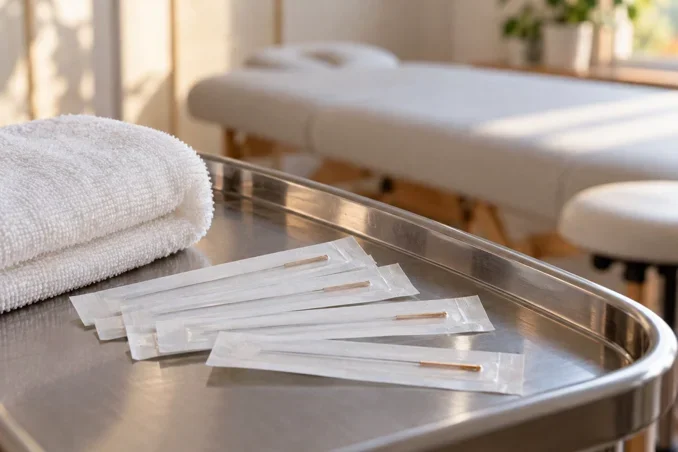
The National Center for Complementary and Integrative Health warns that poor technique or nonsterile needles can cause serious harm. Use a suitably qualified practitioner who follows appropriate infection-control standards and uses sterile, single-use needles. The NHS advises particular caution for people taking blood-thinning medicines, those with an increased bleeding risk, and those with a skin condition or infection. Discuss your health conditions and medicines before treatment, and never stop a medicine to prepare for acupuncture without medical advice.
Ask about the cost of the full course, who will provide it and how concerns will be handled. Travel and appointment time belong in the decision too. Acupuncture should not delay assessment of an unexplained health problem.
Keep the whole care plan in view
The World Health Organization conditionally supports acupuncture as one component of care for chronic primary low back pain, with low-certainty evidence. Its wider guidance stresses care tailored to physical, psychological and social needs, often involving several approaches.
For an interested older adult, the sensible next step is a conversation about suitability, realistic goals and follow-up. There is room for cautious interest here, alongside a clear-eyed look at benefit, burden and risk.
Sources and further reading
2. NIH Research Matters: Acupuncture for chronic low back pain in older adults
3. DeBar and colleagues: BackInAction design and protocol (2023)
4. NCCIH: Acupuncture, effectiveness and safety
5. NHS: Herbal medicines and complementary therapies
6. WHO chronic primary low back pain guideline: recommendations table